Choosing the right shrink tunnel is crucial as it impacts sleeve appearance, line flexibility, installation requirements, and operating costs.
To determine which tunnel style is best suited for your production line, it’s important to understand the strengths and limitations of both steam tunnels and hot air tunnels, and how each might align with your unique packaging goals.
Steam Tunnels
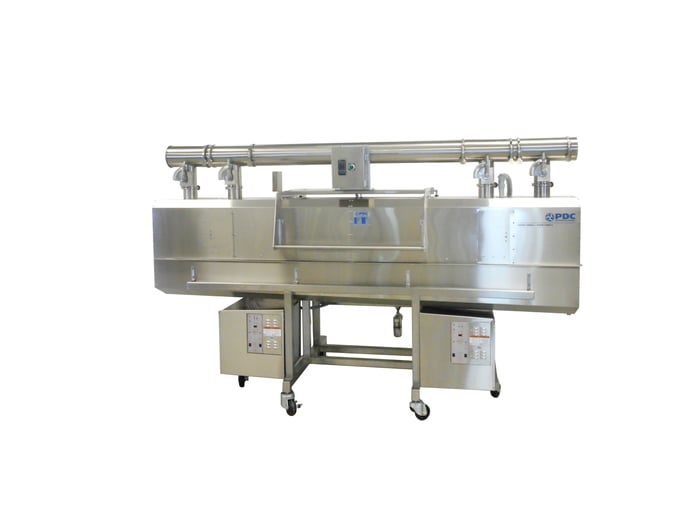
Steam tunnels are widely regarded as versatile and high-quality shrink solutions due to their ability to uniformly distribute heat and conform to complex shapes. Most use controlled-steam zones to uniformly distribute heat around the sleeve, enabling it to conform smoothly to complex container shapes.
Pros of Steam Tunnels
- Most versatile tunnel option on the market
- Highest quality shrink appearance, even on complex shapes
- Works well with a wide array of film types
- Excellent for varied bottle shapes and heights
- Operates at lower temperatures than hot air tunnels
- Can run different containers with minimal or no changeover
Cons of Steam Tunnels
- Requires a boiler system (integrated or remote)
- Some states require a licensed boiler operator on-site
- Produces condensate water that must be drained
- Product exits wet from the tunnel
- Steam may be restricted in certain facilities
- Requires proper venting of steam from the building
Best Applications for Steam Tunnels
Steam tunnels are typically the best choice when:
- High-quality, distortion-free graphics are critical
- Containers have complex shapes or contours
- Multiple SKUs or container sizes run on the same line
- Film versatility is important
Hot Air (Heat) Tunnels
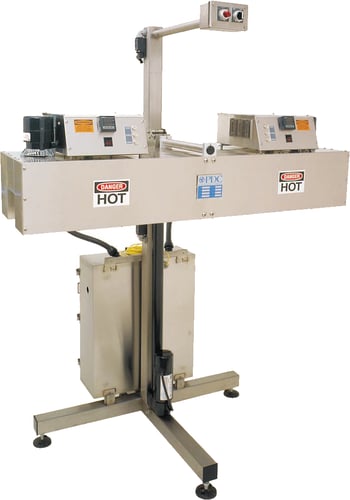
Hot air tunnels use circulated dry heat, which is generated by electric heating elements to shrink sleeves or bands, making them suitable for environments where moisture is a concern. They are commonly used for simple shrink applications or in environments where moisture is unacceptable.
Pros of Hot Air Tunnels
- Ideal for neck bands and tamper-evident bands
- Easy to install and operate
- Lower upfront cost than steam tunnels
- Preferred in pharmaceutical and nutraceutical environments
- Uses dry heat, so products do not get wet
Cons of Hot Air Tunnels
- Can create wrinkles or “fisheyes” on sleeves
- Less versatile than steam systems
- May distort or pull graphics
- High heat can cause discoloration
- Generally produces a lower-quality shrink appearance
- Operates at higher temperatures than steam
- May cause film hazing
- Text, or UPC codes can become skewed or distorted
Best Applications for Hot Air Tunnels
Hot air tunnels are typically the right choice when:
- The application is tamper-evident neck bands
- The environment requires dry heat only
- The container shape is simple or lacking curves
- Budget and installation simplicity are priorities
Key Decision Factors: Steam vs. Heat
To make an informed decision on tunnel selection, consider the following core questions that address key operational and quality factors:
-
What level of shrink quality do you need?
If graphics appearance and distortion-free shrink are critical, steam is usually the better option.
-
What container shapes are you running?
Complex or highly contoured containers typically require steam.
-
Are there facility limitations?
If your facility cannot accommodate steam, a hot air tunnel may be the practical choice.
-
What films are you using?
Some films perform significantly better with steam than with hot air.
-
What is your budget and installation timeline?
Hot air tunnels are generally more affordable and easier to install.
Which Tunnel Is Right for You?
Steam tunnels deliver the highest quality and flexibility, while hot air tunnels offer simplicity, lower cost, and dry operation for specific applications.
The best choice depends on your:
- Container geometry
- Film selection
- Facility constraints
- Product sensitivity to moisture
- Production goals
Partnering with an experienced shrink sleeve equipment provider, like us, can optimize your current production and strategically position your operations for future growth, ensuring the tunnel choice aligns with evolving needs.
Contact PDC International today, and let our team help make your project a success!



 © PDC International Corp. 2026

